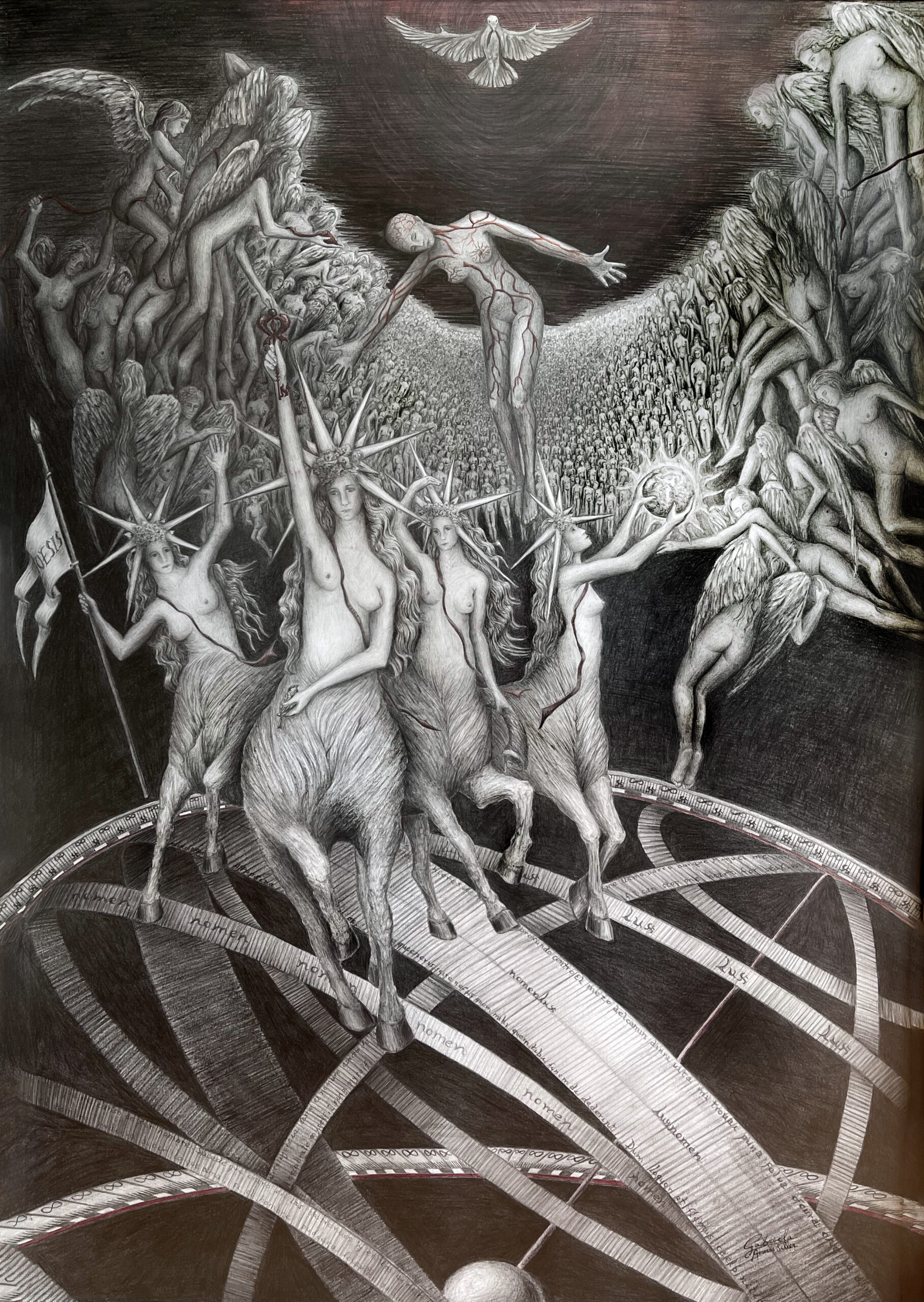
THE TRIUMPH OF POETRY (2016, graphite, Indian ink and marker on cardboard, 70 × 100 cm)
Dove
The dove first appeared as a symbol associated with Venus. Centuries later it was adopted in Early Christian art alongside funerary imagery. In the Book of Genesis, Noah released a dove to verify whether dry land had emerged after the Flood. By the 3rd century, Christian art embraced the dove to represent the Holy Spirit.
The Red Estuary
The artist refers to the levitating central figure as the red estuary: a being in formation, shown with its circulatory system still visible on the surface of its body. Just as an estuary marks the confluence of a river’s fresh water with the sea’s salt water, here the meeting of soul and matter gives rise to the being, with the circulatory system springing forth from this union.
Centaurae
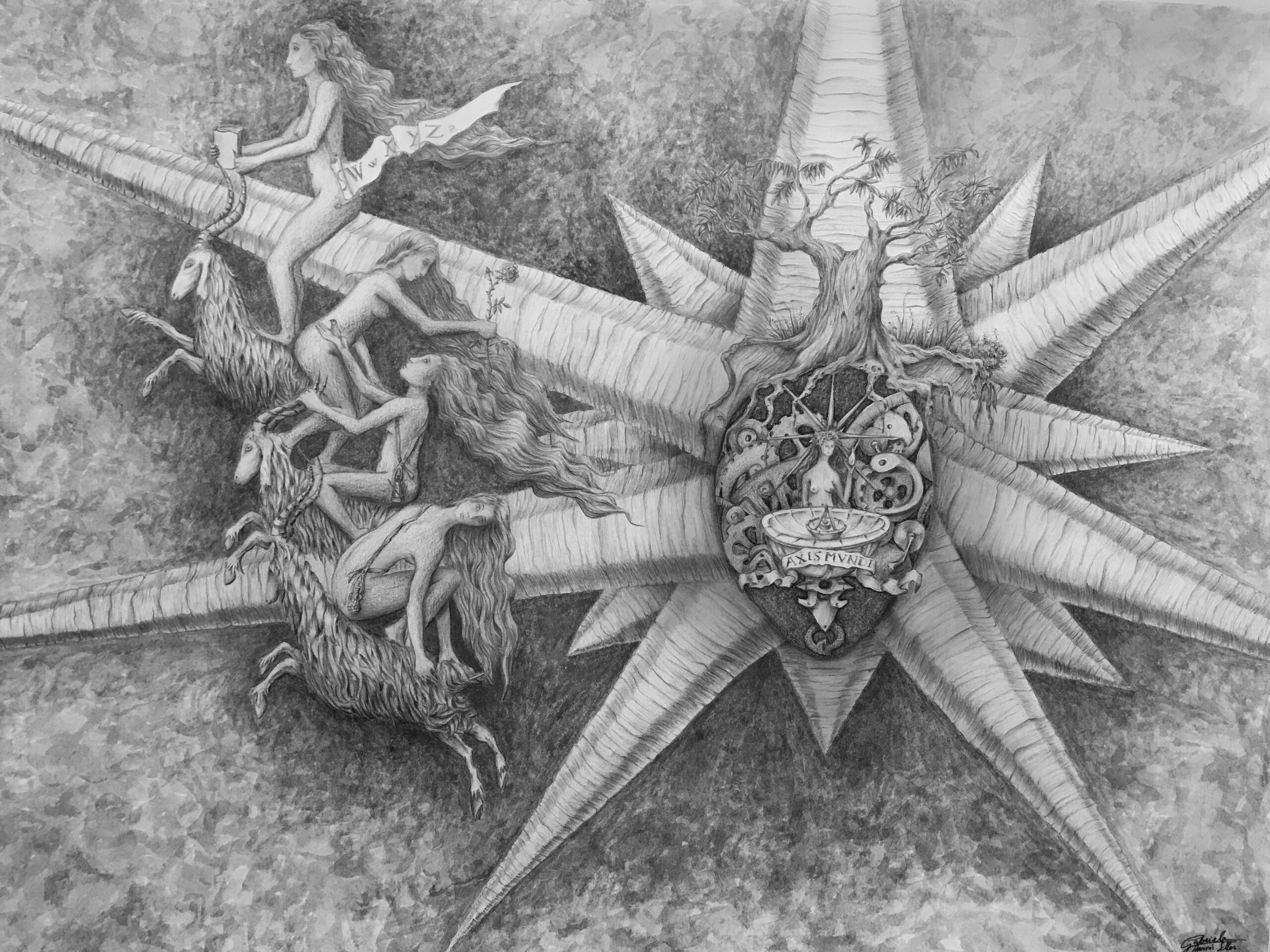
At the center of the composition appear four female centaurs, or centaurides. They embody the union of soul and matter, celestial and earthly, mythical and visible worlds. From their heads rise star-shaped points, for the upper parts of their bodies embody the essence of celestial bodies, while their lower halves are those of wild, terrestrial creatures.
Pound and Ortega y Gasset
On the link between the centaur and poetry, Ezra Pound once remarked that “poetry is a centaur.” José Ortega y Gasset wrote that “man is an ontological centaur,” likely referring to humanity’s perpetual tension between culture and instinct.
Poetry
Each centauride represents an aspect of the poem and the act of poetic creation. The first bears the inscription poesis on a banner. The second holds a key inscribed with the Hebrew letter aleph in one hand, and a sparrow —the poem’s body— in the other. The third embodies rhythm and music, inseparable from poetry. The fourth carries a ball of fire, symbolizing light, for poetry illuminates and awakens us to a primordial vision of the world.
Armillary sphere
The centaurides levitate above an armillary sphere, a classical and medieval astronomical instrument representing the cosmos, reinforcing the celestial dimension of the work.
Poets
Along the bands of the sphere the artist inscribes verses, in their original languages, by Sappho, Horace, Dante, Baudelaire, Neruda, Emily Dickinson, St. John of the Cross, Shakespeare, Rimbaud, Whitman, Cernuda, and Miguel Hernández. Poetry triumphs universally through their words.
Eugenio Trías
Fragments of red ribbon appear on the winged figures, the centaurides, and the dove, symbolizing what Spanish philosopher Eugenio Trías called the thread of truth. The sparrow-bearing centauride bears the inscription Ut pictura poesis. The red thread and the veins of the Red Estuary are one and the same. The left side of the winged beings represents conscious creation, while the right symbolizes the subconscious: they appear asleep, some awakening in the light of poetry.