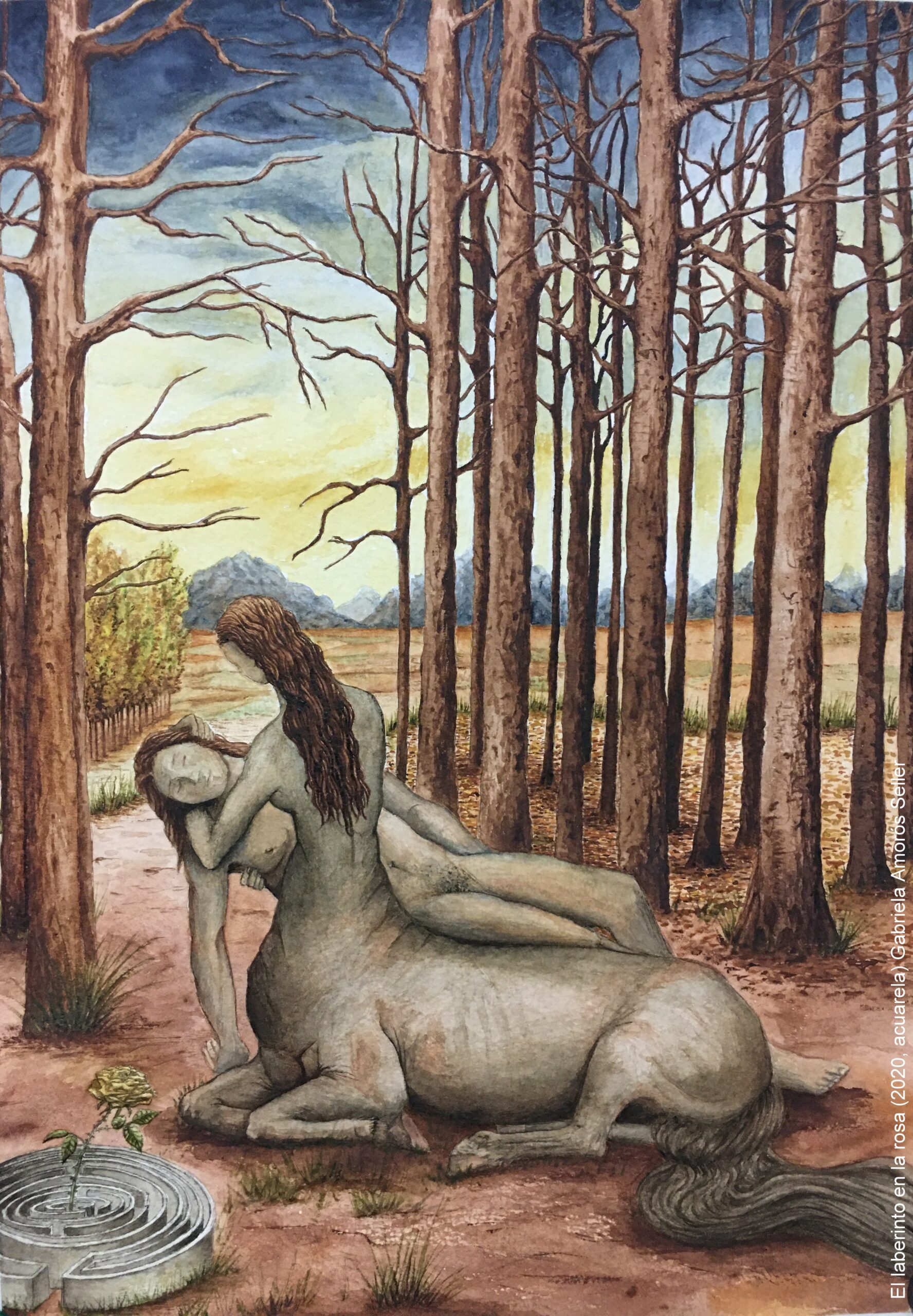
THE LABYRINTH IN THE ROSE (2020, watercolor on paper, 29.7 × 42 cm)
In the foreground, the figures of the labyrinth and the rose precede the scene, positioned as an anamorphic element reminiscent of Hans Holbein the Younger’s The Ambassadors, though placed in the lower left. This evokes the true subject of the work.
The labyrinth and the rose embody three ways of contemplating the creation of Love: through mysticism, alchemy, and finally, an ontological-philosophical vision.
Alchemy and mysticism
In alchemical tradition, the Rose symbolizes the Sun and the Labyrinth the Moon —the masculine and feminine polarities described by Hermes Trismegistus. In mystical terms, the Labyrinth represents Space and the Rose represents Time. Following William Blake’s identification of polarities, space was considered feminine and time masculine.
Cosmic coitus
From a philosophical perspective arise the questions: which came first, the Labyrinth or the Rose? Time or space? Since the Rose is more likely to have been placed at the center afterward, the Labyrinth —as an encompassing space— is first. Thus, the feminine comes before: associated with night (the Moon) and receptivity. Then came the seminal fire (yellow), the seed of the rose that penetrated the labyrinth, sprouted, and grew. Time was founded within space, consummating what Empedocles called cosmic coitus, the source of all life. To reach the innermost essence of the rose, one must traverse space —equivalent to movement in Aristotelian, Heraclitean, Stoic, and Nietzschean thought. Without movement there is no existence; life as a static state does not exist. All is change: knowledge, creation, being itself.
Love
From this cosmic union of space and time emerges the third dimension: Love, embodied by the centauride and the knight. They are Space (the centauride) and Time (the man), now transformed into beings who share both dimensions through Love. The centauride, a mythical creature, belongs outside of time and thus embodies space; her hybrid form represents one space occupied by another. The knight represents the ephemeral, the temporal (the Yellow Rose). Both figures share the color of clay, signifying their birth directly from the earthly cosmic union of space and time.
Pietà of Rondanini
Together they resemble a mannerist Pietà, akin to Michelangelo’s Pietà Rondanini. The mortal man, or Time, through the embrace of atemporal Space, becomes Eternity: Immortal Love, born of the union of Space and Time.
Visual metonymy
An analogy is drawn between labyrinth and rose: each mirrors the other’s form, so that the rose appears labyrinthine and the circular labyrinth takes the shape of a rose.
Theory of opposites
The labyrinth, made of stone, appears static and immutable, embodying the feminine, mythical dimension of Space. By contrast, the rose unfolds dynamically, embodying Time as something transient and alive —the masculine counterpart.